


The Cat’s Meow’s Guide to Pet Recovery

petrecoveryguide_apr2009

INTRODUCTION

Over 10 million pets are reported lost every year, and of those, only 1 in 50 cats finds her way home, according to TogtherTag.com. What can you do to increase the odds that if your cat is lost, she’ll be one of the lucky ones who is reunited with her owners?

The good news is, there’s a lot you can do, both to decrease the chances that your cat will be lost in the first place, and to increase the odds that you’ll find her if she is. We’ll cover both and provide you with a comprehensive pet recovery plan that will help you find your cat quickly and safely if she disappears.

There are two tiers to any pet recovery plan: prevention and recovery. If you have a well-executed prevention plan, you may never experience the anguish of losing a cherished pet. The Cat’s Meow has published scores of stories on missing cats, and in many cases, the cat owners were lax in keeping the cats secure. You can learn from their mistakes. In other cases, the owners did a lot right, including keeping their microchip contact information current for months–or even years–after the cat’s disappearance.

First, let’s look at what you can do to keep Fluffy from disappearing.

PREVENTION

SECURE YOUR CAT

It’s hard for your cat to go missing if she can’t escape from your home. Take a few minutes to determine if there are any weaknesses in your home’s security that your cat can exploit to escape:

Check windows and balconies for egress points

Every cat has a little Houdini within her, and at some point it will surface, even if she has to wait five years for the opportunity to present itself. Make sure that your windows and balconies don’t offer a means of escape. Even if a window is open just an inch or two, many cats can worm their way through the gap. Either leave your windows closed or install screens. Check the screens periodically to ensure they are tight and secure.

Balconies offer another tempting point of escape, and if you live in a high rise, escape can prove fatal. Forget all the heartwarming stories of miracle cats who have survived high rise falls unscathed: for every happy ending there are many more gruesome, unhappy outcomes.

Even if you’re not in a high rise, cats do escape from balconies, either purposely or by falling. We’ve installed mesh netting over the top of balconies we have off of two of our bedrooms. The cats can enjoy sunny afternoons on the balcony via a cat door, but they cannot jump up on the rail to escape or fall.

Lock up Fluffy when outsiders visit

It’s important to remember that people who are not “cat people” will leave doors and windows open without a thought for your cat’s safety. Anytime anyone visits your home — family, friends, service workers, etc. — consider locking your cats in a spare room for the duration of the visit. I can tell you from personal experience that begging and pleading with (or swearing at) visitors to keep the doors closed does not work.

Install cat fencing

Cat fencing allows your cats the freedom of exploring the outdoors from the safety of your backyard without being able to escape its confines. It also prohibits stray cats from entering.

Moving or renovating? Take Fluffy to daycare.

If you’ll have workmen coming and going, or if you are moving and it’s not feasible to contain your cat in a spare bedroom, consider dropping your cat off at a boarding facility for the day. Many offer 9-5 daycare.

GOOD HABITS

Incorporating the following habits into your routine will help you avoid the pitfalls that many cat owners fall into when they let up their guard and Fluffy capitalizes on it to escape:

Always transport Fluffy in a carrier.

A lot of cats escape when car doors are opened, or when being carried in an owner’s arms into a vet’s office. No matter how mellow your cat is, the sight of a barking Rottweiller coming up the sidewalk or the sound of a car’s backfire can trigger the flight response before you’re fully aware of what’s happened.

Even if you’re traveling long distances and let Fluffy run free in the car while you’re on the road, be sure to secure her within the carrier before anyone opens a car door. No exceptions.

Can’t afford a carrier? You can get a portable cardboard carrier for less than ten bucks, and it folds flat for easy storage.

Wriggle-Free HarnessConsider harnessing your cat when traveling.

One of the advantages of a harness is that if your cat is escaping or squirming, you have something solid to grab onto aqnd thwart escape. We use a body harness (right) that is lightweight, unobtrusive, and as difficult to escape from as a kitty straightjacket. It attaches with industrial strength Velcro®. If necessary, I can yank Skeezix up out of harm’s way by the leash without him slipping out of the harness.

Never ever let Fluffy roam free in an unfamiliar place.

I just heard about 98% of you say, “Well, DUH!” It seems so obvious, right?

Well, you all can skip to the next point, while I convince the other 2% who are still unclear on the concept that letting a cat roam free is never a good idea. It’s not a good idea at home, and it is NEVER a good idea away from home. Last year, the Ayers family was on an RV trip to Yellowstone, and let their cat Fluffy (yes, her real name) wander freely at the campsite as was their habit. Fluffy did not return and they continued home to Houston, Texas without her. Long story short, they were reunited miraculously many months later, and they’re back to taking Fluffy on RV trips with them. And yes, they’re still letting her roam free at each campsite. This family is irresponsible on so many levels, it’s hard to know where to start, so I’ll just sum it up by insisting that you never let your cat roam free in an unfamiliar place. Period.

BE PREPARED

Thinking ahead will pay dividends if your cat ever goes missing. Put the following on your To-Do List:

Take clear, good quality photos of your cat.

If your cat is ever lost, you’ll need good photos of her for flyers and to show around to vets and neighbors. Take a good head-on face shot, two profile shots, and if appropriate, a tummy shot or additional photos that show unique markings. Keep prints in your file drawer, and upload digital versions to an online photo sharing site like Flickr so that if your home or computer is destroyed, you’ll be able to access the photos.

Some pet recovery services like TogetherTag.com provide lost cat flyers as part of their service. You upload your cat’s photos and information when you set up the account, and if Fluffy is ever lost you can create high-quality flyers in just a few mouse-clicks. If you’re a member of a service like this, don’t skip this important step.

Train your cat to come when called.

This is easier than it sounds, but it works best if you start the training when the cat is young. We use a combination of whistling, calling the cat’s name, and a hand signal, reinforced with treats. Whistling comes in handy when searching for lost pets because the sound tends to carry farther.

Our very vocal Siamese, Mao, will not only come when called, but also responds vocally. This trait was invaluable when he was locked in a neighbor’s garage. We lived on a very steep hill with winding streets, and it took a while to determine Mao’s location. Hubby and I spread out, and like playing a pool game of Marco Polo, we continued to call to him until, by triangulation, we located him.

Spay or neuter your cat.

Cats are many times more likely to wander if they are not spayed or neutered. You’ll end up with a calmer companion who’s content being a homebody, and it’s also the right thing to do.

Get to know your neighbors.

Sometimes it takes a village to find a cat. One of the most valuable tools in your pet recovery arsenal is the good will, eyes and ears of your neighbors. In an age where many neighbors no longer know–or even have met–each other, it’s good to cultivate relationships with those on your street so that if your cat ever goes missing, you’ll have 20 families–not just one–looking for Fluffy, and hoping and praying for her safe return.

TAG, CHIP & BELL YOUR CAT

Your best defense against losing your cat forever is to microchip your cat and affix an identity tag and a loud bell to her collar. Sound like overkill? Each has its place and complements the other to provide a three-pronged defense system that will help you locate your cat before she gets too far from home, and failing that, will reunite you if she is lost.

Your indoor-only cat is not exempt. Indoor cats haven’t been granted immunity from going missing, and even if they never leave your home, if a natural disaster strikes your area and you’re not home to rescue your cats, they could survive the initial disaster only to end up hopelessly lost. Additionally, if you need to evacuate and leave your cat at a temporary rescue shelter, many require that animals left in their care have collars and tags.

Here’s why you need to do all three:

Bells

collarbellsIf your cat escapes from your house, you may have a hard time seeing her hiding in shrubbery or underbrush. A bell on Fluffy’s collar can serve as an audible locator to help you find her before she becomes truly lost.

It will also help you find a cat who has gotten sick and crawled in the back of a closet or cupboard. She might not respond to your calls, but might move her head enough to sound the bell and alert you to her location. I always add a loud bell or two (or six) to the default bell that comes with the collar. It sometimes sounds as if Santa’s sleigh is charging through the house, but I always know where each cat is.

With that said, some argue that a bell on the cat’s collar can function as a dinner bell for coyotes. If you live in an area with a coyote threat, evaluate whether the risk is too high.

Identity Tags

Tags have come a long way since the basic “Fluffy 555-1212″ version with which most pet owners are familiar. Technology has caught up, and now you can get web-enabled tags (TogetherTags, for example, at right) that provide a wealth of important information about your cat should she ever get lost. Each tag is printed with a URL and an ID code, which when entered online can provide extensive contact information (including out-of-area contacts), photos of your pet and your pet’s medical history and veterinarian’s info.

Often, cat owners who have their cats microchipped falsely assume that the microchip obviates the need for a tag. There is never a guarantee that your cat will be found by someone with access to a microchip scanner (one of our Catster friends who lost her cat this week bemoaned the fact that the local shelter did not have a scanner), and a lot of people who find lost pets just don’t think to have the animal scanned. If a neighbor finds Fluffy, he might keep her for a few days waiting to see if any lost cat flyers go up in the neighborhood rather than taking her to a shelter and risking that she might be euthanized. In the interim, if Fluffy is on medication, a delay could be life-threatening. With a tag, whoever finds your pet can call and arrange for an immediate reunion.

If you opt for a low-tech collar with a telephone number, be sure to include your area code. Cats stow away in moving trucks and other vehicles, and can be found hundreds–or even thousands–of miles away.

Microchipping

Cats lose collars. One of my cats goes through an average of a collar a month. Microchipping takes over where the collar leaves off to provide a permanent means by which pet owners can be identified and contacted even if your cat has lost her ID tags. Most microchip services offer a web interface through which you can update your information when you move so that you can be contacted when Fluffy is found weeks, months, or even years later anywhere in the country.

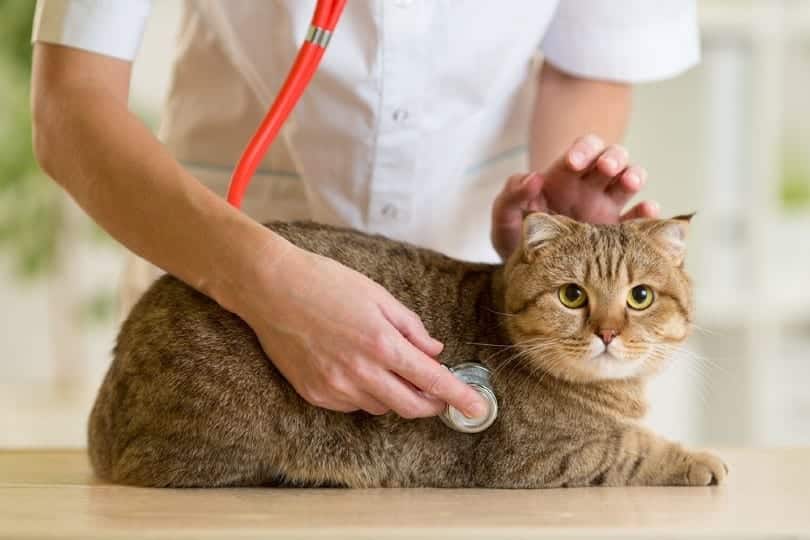
Implanting a microchip takes just seconds, yet provides a lifetime of protection for your cat. A veterinarian injects a tiny chip about the size of a grain of rice beneath the surface of your pet’s skin between the shoulder blades. It’s similar to a routine vaccination. Anesthetic is not required.

The microchip has no internal energy source, so it will last the life of your pet. It is read by passing a microchip scanner over the pet’s shoulder blades. The scanner emits a low radio frequency that provides the power necessary to transmit the microchip’s unique code and positively identify the pet. If your pet gets lost and is taken to an animal shelter or veterinarian, they will scan the microchip to read its unique code and retrieve your contact information:

microchip

Many shelters offer low-cost microchip clinics; contact your local shelter to find out if they offer this service in your area. Microchipping is a highly effective way to reunite owners and their pets. Read the microchip success stories in The Cat’s Meow.

Not sold on microchipping? Check out The Cat’s Meow’s post that debunks the most common microchip myths.

RECOVERY

No matter how well you’ve adhered to the prevention guidelines, there’s still a chance that Fluffy could go missing. If she does, your chances of recovery are greater if you rally your neighbors around the cause and stop at nothing to get out the word.

mrd.jpgLast year in New Zealand, a cat named Darwin (aka “Mr D”) was reunited with his owner after being lost for six months. His mom’s story is a testimony both to perseverance and the sacred bond between a cat and his caretaker. Mr D’s mom didn’t stop at putting up flyers and checking the shelters. With some creative, outside-the-box thinking, she tirelessly raised awareness of Mr D’s plight. She donned a plushie cat suit and stood at the side of the busy road at rush hour with a super-sized flyer. The stunt landed her on the television news. Her efforts were ultimately successful, and she provided input on many of the recovery tactics listed below.

Your efforts can be successful, too, if you approach recovery both methodically and creatively. If you’re a left-brain type, have a brainstorming session with right-brain family members and friends who might come up with off-the-wall — but effective — search strategies.

Here’s an action plan that can provide the foundation of a recovery campaign to bring Fluffy home.

  • Hold a family meeting and construct a timeline to determine where and when your cat was last seen. This can help focus your initial search. Have there been visitors to the house? Contact them to see when they last saw the cat, and verify that the cat didn’t hitch a ride with them. Some cats LOVE to stow away in the car.
  • Mobilize immediately. If you’ve ever watched “Without a Trace,” you know that the first 24 hours is the most crucial in finding someone who’s missing, and that goes for cats, too.If you assume that your cat will “come home in the morning” and thus decide to wait it out, you’re sacrificing your chances of success in doing so. If your cat was injured, she’ll need medical care. If she was spooked and ran away from danger, she’s getting further from you with each tick of the clock.
  • Most cats are found within a mile of their homes. Print a map and draw a one-mile radius around your home (use Google Maps, and select the “Distance Measuring Tool”). For at least the first day or two, concentrate your search efforts within this perimeter. As the days pass, gradually widen it, but keep in mind that you are most likely to find your cat within that circle.
  • Post Flyers everywhere. Here are some guidelines for creating your flyers:
FLYER GUIDELINES:

  • Display a large clear photo of your cat.
  • Provide a succinct unambiguous description. Do not assume that everyone is familiar with a breed. For example, don’t just say, “Siamese.” Add a description: “Dark brown face, tail, legs. Cream-colored body.”
  • Include gender, eye color, weight or body size, coat length, age.
  • If you’re offering a reward, print “REWARD” in big letters, but do not specify the amount.
  • Print your phone number, but do not post your name or address.
  • State the area in which your cat was lost (lost on Maple near Elm St). and the date she was lost.
  • Make sure multiple copies of your phone number are printed in a tear-off area at the bottom of the flyer.
  • To avoid scams, withhold at least one identifying characteristic, then ask the caller to describe it. For example, Fluffy might have a heart-shaped black patch on her tummy, or might be missing a front tooth. When the caller contacts you, you can ask, “How would you describe the markings on her tummy,” Or, “Which one of her teeth is missing.?” (If they can’t answer correctly, they don’t have your cat and it’s likely a scam.)
  • Some suggest printing your flyers on fluorescent card stock to increase visibility. This is a good idea, but first, make sure it doesn’t compromise how well your cat’s photo is displayed.
  • If you live in an area with frequent rain showers, enclose each flyer in a plastic binder sleeve (if it’s a top-opening sleeve, make sure the opening is at the bottom.)
  • Contact Animal Control and the Department of Transportation (DOT) to confirm or eliminate the possibility that your cat was killed.
  • As you call for your cat, don’t forget to LISTEN. This is where that collar bell can come in handy. Your cat might not respond vocally, but her body’s movement may trigger the bell.
  • In addition to calling or whistling for your cat, she might also be lured into coming to you when you start playing with her favorite toy. Skeezix immediately comes running when he hears us swish his tinsel wand toy through the air, even if he is holed up in a closet on a different floor of the house.
  • Bring a powerful flashlight (even during daylight hours) for checking in dark spaces.
  • Explore every nook and cranny of your house, including the space behind water heaters, under furniture, in furniture (inside a box spring or couch), under beds, in closets and cupboards, in drain pipes, in sewer drains, in culvert pipes, under vehicles, in crawl spaces under the house, inside sheds and barns, attic crawl spaces, on the roof, in roof gutters and in trees. Look behind, under, and inside appliances, including washing machines, clothes dryers, refrigerators, and dishwashers.
  • Spread the word in person. The best way to get your message out there is to talk to as many people as you can. Knock on every door in your neighborhood, and leave a flyer. Go to every veterinary office and shelter in person. Making a personal connection will help engage each person you talk to in the search. Here are a few ideas:
    • Contact veterinarians, shelters and rescue organizations in person, and revisit every few days.
    • Find out what the holding period before euthanasia is at every local shelter. With recent budget cuts and overcrowding, it may be shorter than you think. Make sure you check in with them every day or two to ensure your cat isn’t euthanized before you can claim her.
    • Give flyers and a dog treat to everyone in the neighborhood out walking their dogs.
    • Give flyers to delivery people, including postmen, UPS and FedEx drivers.
    • Talk to service people, including gardeners and contractors. Your cat may have gone for a ride. Check areas (stop signs, stop lights) where your cat may have jumped out of the truck.
  • Have you had any furniture hauled away recently? Cats are notorious for stowing away in box springs or inside of sofas.
  • Look in drains and culverts. If you can’t see into these areas, use a camera at arm’s length or on a rod with time delay so you can take a photo and view it on the computer.
  • Check vacant houses and garages (your cat could be locked in).

All of the above are standard tactics. But don’t stop there and don’t give up hope. Some of the following tactics are unconventional (and maybe even a little embarrassing), but they may be just what you need to bring your cat home safely:

  • Dress up in a cat suit and stand next to an oversized flyer on a busy road during rush hour.
  • Post a large sign or oversized flyer on your front fence.
  • Set cat traps and use a baby monitor to moniter the traps.
  • Make a smoothie of smelly cat food and leave a trail leading back home.
  • Install motion-activated cameras.
  • Create food stations around the neighborhood.
  • Leave food and water outside, with smelly clothes that have your smell on it. Gym clothes and sleep clothes are well-suited for this.
  • Cook smelly cat food on a BBQ ( the heat makes the food smell stronger).
  • Walk the streets calling for your cat, especially at dusk, dawn or 4 am in the morning when cats are the most active.
  • If you see a cat food bowl outside, leave a flyer near it.
  • Any cat hoarders around? Check ‘em out.
  • Check stray cat feeders and feral colonies. Talk to the people who maintain those colonies.
  • Put signage on your car.

Online Resources

The Catster group Alfie and Mr D’s Purrs and Woofs for the missing is an excellent resource when you’ve lost a pet. They welcome all cats and dogs.

The MCA (missing cat assistance) group on Yahoo is a group for people are actively looking for their kitties. It’s a great place to bounce ideas off each other.

PET RECOVERY SERVICES

There are two types of pet recovery services: 1) The pet detectives that attempt to track down your pet, and 2) Services that contact as many people in your neighborhood as possible to get the word out.

Pet Detectives: The most effective pet detectives are those who use bloodhounds or other scent-sniffing dogs to track your lost cat. Even if they are not successful in finding your cat, they can help point you in the right direction to search. LostAPet.org is a non-profit that offers pet detective services and training.

Contact Services: If you don’t think flyers are sufficient to get the word out, or you live in an area where flyers are prohibited or frowned upon, consider a service that blasts your message to everyone within a radius that you specify.

FindToto.com gets the word out through robo-calling, using automated phone calls to tell your neighbors about your lost pet. The advantage of this service is that it can get the word out within minutes of placing your order. There are several disadvantages, however. It’s illegal in some states, including California. Some recipients will find it as intrusive as telemarketing calls. If recipients delete the voicemail message (as most will), then spot the cat days later, they have no way of retrieving the contact info. And, a verbal description of a pet is just not as powerful as a photo.

Recognizing this, SeenMyPet.com and similar services send out a direct mail postcard blast to everyone in a radius that you specify. Essentially, they are delivering mini-flyers into the hands of everyone in the area where Fluffy has disappeared. The biggest disadvantage to this type of service is the time lag: it can take three days or longer to print and deliver the postcards.

Members of microchip and tagging services like TogetherTag.com can create a customized web page to include and maintain their pet’s photos, a detailed description, and emergency contact information. If your pet is lost, the service immediately emails or faxes a poster of your pet and information to all members, shelter groups, veterinary clinics, groomers, trainers, pet supply retailers, and shops that are up to a pre-determined radius of where your pet was last seen. If your cat is microchipped, this service may already be available to you, so check it out.

CLAIMING YOUR CAT AND AVOIDING SCAMS

It’s unfortunate, but there are lots of scams involving lost pets, especially if there is a reward involved. The following steps can keep you from being the victim of a scam:

  • Do not volunteer information about the cat’s identifying characteristics, but have the caller describe the cat in detail. Don’t ask leading questions like, “Does she have a spot on her belly?”
  • Never respond to a “found” pet contact alone. Take a friend with you.
  • Always meet in a public place.
  • Never give reward money until you have your pet in hand and have verified that the cat is yours. It is very unusual for a legitimate pet finder to harass or threaten you for a reward. It’s likely a scam if someone repeatedly calls you and gets nasty or threatens to harm your pet if you don’t send the reward money. Anyone who insists on getting the reward money in advance is likely a scammer.

Here are some of the most common scams:

  • Someone claims to have found your cat, but took her with them back home to a foreign country and needs you to wire money to have the cat shipped back to you.
  • Caller claims to be an out-of-state trucker who found your injured cat while driving through the area. He claims that he took the cat to a vet, but needs you to wire him money so he can pick your pet up and send it back with another trucker in the same company who is driving back your way.
  • A caller claims to have found an animal that might be yours. In the process of extracting a description from you, the caller will say that he’s found a different animal, not yours. He’ll apologize for your loss, and for taking your time. This is a set-up–he passes the information he’s gotten about your pet to a partner who calls a short time later and claims to have found your pet. That person will try to collect any reward money in advance.

WHEN THE SEARCH IS OVER

No matter what the outcome, once the search is over, remember to do the following:

  • Take down all your flyers, including those in vet offices, pet stores and shelters. (To facilitate this, when you are putting the flyers up, note their location on a map of your neighborhood that you’ve printed.)
  • Send thank-you notes to everyone who was especially helpful in the search. If someone has really gone the extra mile to help, bake them a batch of cookies, or give them a gift card.
  • If the outcome is a happy one, put up a big sign in your yard, and thank the neighbors for their help.
  • If your lost cat was not tagged or microchipped, order a tag and schedule a chip implant.
  • If you have a great pet recovery story or additional tips, please send your story to The Cat’s Meow!

Losing a pet is a anguishing, stressful experience, and I hope you never have to go through it. But if you do, and you execute this pet recovery plan, you’ll be comforted in knowing that you did everything possible to bring Fluffy home.

Got an emergency plan? What would you do in case of fire, flood, earthquake, tornado or hurricane to ensure your cat’s safety? Read The Cat’s Meow’s Guide to Emergency Preparedness.

More articles from The Cat’s Meow:

Back to The Cat’s Meow Blog

Share and Enjoy:
  • Digg
  • del.icio.us
  • Facebook
  • Mixx
  • Live
  • Reddit
  • Sk-rt
  • StumbleUpon